
Summary:
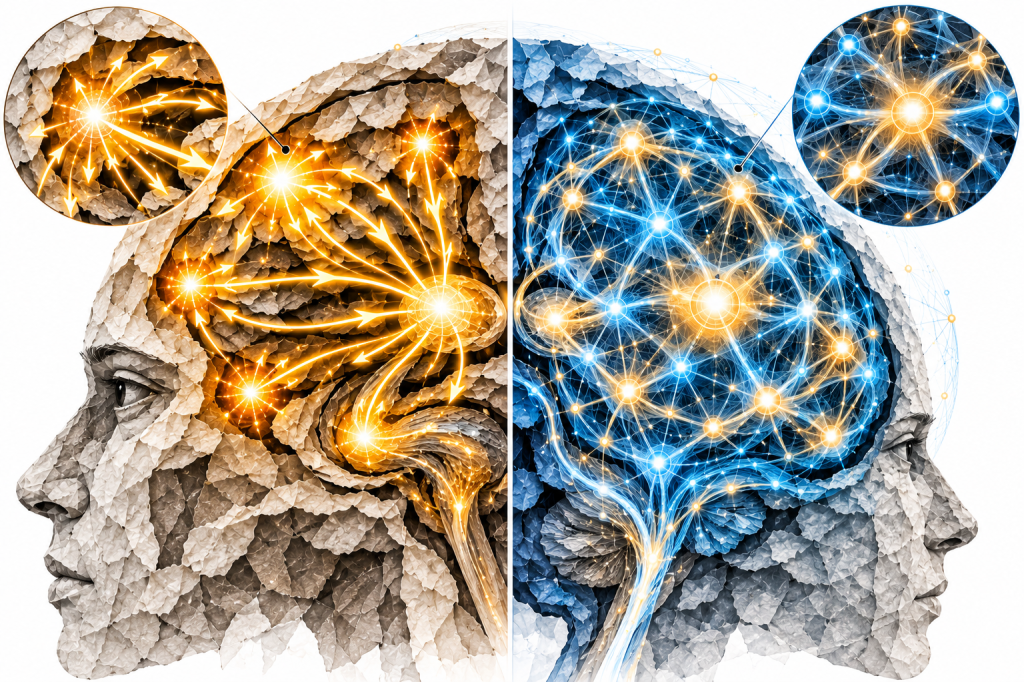
Scientists are currently engaged in a massive global effort to decode how 4 pounds of biological tissue creates the subjective experience of being alive. The leading frameworks include Global Neuronal Workspace Theory, which views the brain as a spotlight system, and Integrated Information Theory, which proposes that consciousness is a mathematical property of complex systems.
Newer research into heart-brain coherence and quantum biology suggests that our awareness may not be confined to the skull but is instead an emergent property of electromagnetic fields and quantum coherence within cellular structures. Understanding these theories allows individuals to use neuroplasticity and biohacking tools to optimize their mental state, achieve deep happiness, and unlock latent human potential.
The study of consciousness was once relegated to the fringes of mysticism and late-night philosophy sessions. Today, it has become the most prestigious frontier in neuroscience and biophysics. We are no longer satisfied with simply knowing which parts of the brain light up when we see a sunset. We want to know why that sunset feels like something. This search for the source of subjective experience is often called the hard problem of consciousness.
As we stand at the intersection of quantum physics, AI, and neurobiology, we are discovering that the human mind is far more than a collection of mechanical switches. It is a dynamic, self-regulating field of energy that bridges the gap between raw data and lived meaning. At LightWeave Foundation, we’re exploring how technology can measure, detect, understand, analyze, and leverage this data about ourselves, how it can improve our lives, help us make better decisions, let us experience the world differently, and ultimately elevate our consciousness.
This shift in perspective is not just academic. It has profound implications for how we live, breathe, and perform. If consciousness is a measurable physical process, it can be hacked, optimized, and expanded. By merging the rigorous data of Integrated Information Theory with the practical applications of heart-brain coherence, we can develop a blueprint for high-level human functioning. We are moving toward a future where neurofeedback and consciousness technology allow us to dial into specific states of flow and creativity at will. This guide explores the leading scientific theories of awareness and provides a protocol for aligning your biology with the quantum field.
Table of Contents
- How does the global neuronal workspace explain our focus
- Can integrated information theory measure the soul
- Is the heart the hidden conductor of our conscious experience
- Does quantum coherence play a role in the biological brain
- How can neuroplasticity reshape our subjective reality
- The Quantum Pub Heart-Brain Coherence Protocol
How does the global neuronal workspace explain our focus?
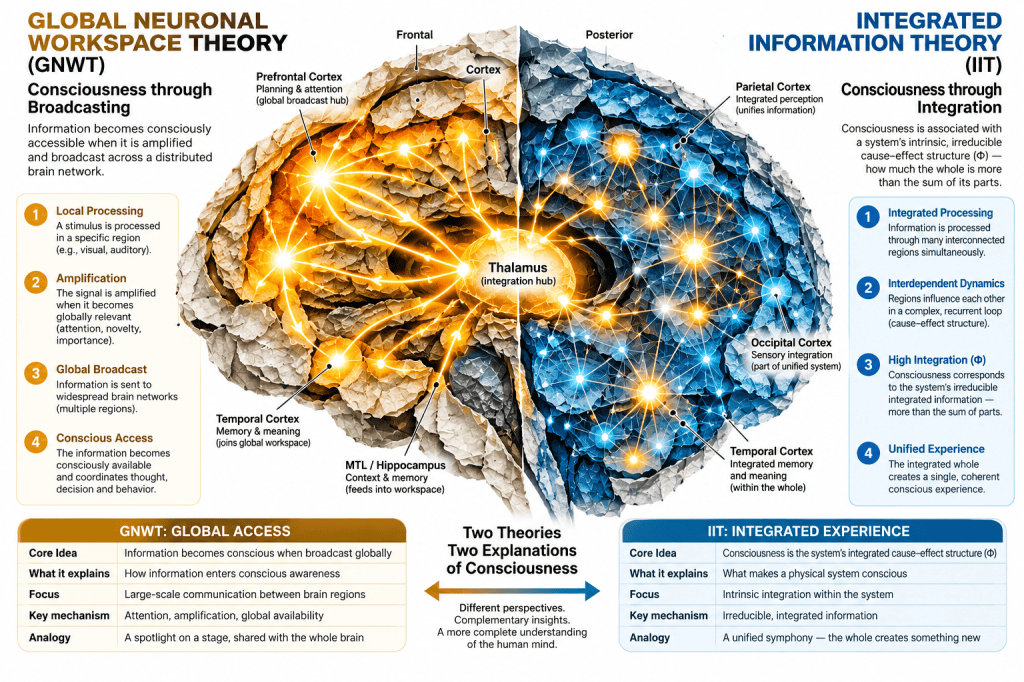
The Global Neuronal Workspace Theory, or GNWT, is one of the most widely accepted models in modern neuroscience. Think of your brain as a massive, dark theater filled with specialized actors. Some actors are responsible for color, others for sound, and others for specific memories. Most of the time, these actors are performing in the dark, doing their work subconsciously. Consciousness, according to GNWT, happens when a spotlight shines on a specific group of actors. This spotlight allows their information to be broadcast to the rest of the theater. Once that information is globally available, you become aware of it.
This theory suggests that the prefrontal cortex acts as a distribution hub. It takes snippets of data from your senses and amplifies them so that the entire brain can use the information. This explains why you can drive a car for miles without thinking about it, which is subconscious processing, until a deer jumps into the road. Suddenly, the deer data is broadcast to the global workspace, and you become acutely conscious of the danger. The challenge with this theory is that it describes the function of consciousness but still struggles to explain the actual feeling of awareness. It treats the brain like a computer, but many argue that consciousness is more than just data sharing.
Can integrated information theory measure the soul?
Integrated Information Theory, often called IIT, takes a completely different approach. Developed by neuroscientist Giulio Tononi, this theory suggests that consciousness is not a result of what the brain does, but what the brain is. It proposes that any system with a high degree of integration and complexity possesses some level of consciousness. The theory uses a mathematical metric called Phi to calculate exactly how conscious a system is. If a system is highly interconnected, meaning the whole is greater than the sum of its parts, Phi is high.
This theory is revolutionary because it implies that consciousness might not be limited to humans or even biological life. If a computer or a network reached a certain level of integrated complexity, it could, in theory, be “conscious”. IIT focuses on the internal structure of the system rather than its external behavior. Critics argue that the math is too complex and that it might lead to strange conclusions, such as simple logic gates being conscious. However, for those looking to unlock human potential, IIT provides a fascinating goal. By increasing the complexity and integration of our own thoughts and sensory inputs through deep learning and meditation, we are essentially increasing our Phi and expanding our field of awareness.
Is the heart the hidden conductor of our conscious experience?
While most theories focus on the brain, a growing body of evidence suggests that the heart is a primary driver of our conscious state. The heart contains a complex network of neurons often called the little brain in the heart. This network sends more information to the brain than the brain sends to the heart. When we experience stress, our heart rhythms become jagged and incoherent, which sends signals to the brain that shut down higher reasoning centers. This is why it is hard to think clearly when we are angry or afraid.
Conversely, when we practice heart-centered emotions like gratitude or compassion, our heart rhythms become smooth and sine-wave like. This is known as heart-brain coherence. In this state, the heart acts as a powerful electromagnetic conductor, pulling the brain’s neural activity into a synchronized rhythm. This coherence allows for greater neuroplasticity, better decision-making, and a sense of deep happiness. Biohacking this connection is one of the fastest ways to change your subjective experience of reality. By shifting the rhythm of the heart, you literally change the operating system of the brain.
Does quantum coherence play a role in the biological brain?
One of the most visionary theories in this field is the Orchestrated Objective Reduction theory, or Orch-OR, proposed by Roger Penrose and Stuart Hameroff. This theory suggests that consciousness originates from quantum computations inside tiny structures within neurons called microtubules. In the classical view, the brain is a collection of wires. In the quantum view, the brain is a quantum computer that can access information at a level deeper than atoms and molecules.
Quantum coherence occurs when particles act in unison, allowing for instantaneous communication across distances. If this happens in the brain, it would explain why our conscious experience feels unified rather than fragmented. While many mainstream scientists are skeptical because the brain is considered too warm and wet for quantum effects, recent discoveries in photosynthesis and bird navigation show that biology has found ways to harness quantum mechanics. If our brains are indeed quantum-coherent, it means our consciousness is connected to the fundamental fabric of the universe, allowing for levels of intuition and perception that go far beyond our five senses.
How can neuroplasticity reshape our subjective reality?
The beauty of all these theories is that they lead to a single conclusion: your consciousness is not fixed. Through the principle of neuroplasticity, the brain is constantly Rewiring itself based on your experiences and focus. Every time you engage in a new thought pattern or practice a specific mental state, you are physically carving new pathways in your neural architecture. This is where human potential becomes a measurable science.
If you choose to focus on states of high coherence and integrated information, your brain will eventually default to those states. This is the essence of consciousness technology. By using tools like neurofeedback, meditation, and rhythmic breathing, you are not just relaxing. You are training your nervous system to operate at a higher frequency. You are moving from being a passive observer of your mind to being the lead editor of your own reality. The goal is to create a brain that is highly integrated, globally connected, and quantum-resonant.
The Quantum Pub Heart-Brain Coherence Protocol
- Daily Repetition. Perform this protocol twice daily to harden these neural pathways. Consistent practice ensures that your baseline state of consciousness remains elevated, resilient, and deeply happy.
- Heart Focused Breathing. Shift your attention to the area of your chest and imagine your breath flowing in and out of your heart. Breathe slowly and deeply, finding a natural rhythm that feels comfortable.
- Activation of Positive Emotion. As you continue breathing, conjure a genuine feeling of appreciation or care for someone or something in your life. This shift in emotion changes the electromagnetic signal of the heart.
- Cognitive Integration. While maintaining the feeling of gratitude, visualize a complex problem you are trying to solve. Allow the integrated information from your heart to inform the workspace of your brain.
- Neural Anchoring. Hold this state of coherence for at least five minutes. This timeframe is necessary to trigger the release of hormones like oxytocin and DHEA which support neuroplasticity.


Leave a Reply