Summary
Current scientific research into consciousness employs high-resolution neuroimaging and electromagnetic monitoring to map the internal landscape of the mind. By utilizing Electroencephalography to track brainwaves and functional Magnetic Resonance Imaging to observe blood flow, researchers are identifying the neural correlates of awareness. While these tools excel at measuring physical activity, the subjective experience of being alive often remains elusive.
Emerging fields like quantum biology suggest that consciousness may arise from synchronized energy states between the heart and brain, a phenomenon known as coherence. By mastering these biological signals through neuroplasticity and biohacking, individuals can potentially unlock higher states of cognitive function and deep emotional resilience.
For centuries, the study of consciousness was reserved for philosophers and theologians who debated the nature of the soul from ivory towers. Today, the laboratory has replaced the library. We are witnessing a monumental shift where the subjective feeling of “I am” is being decoded through the lens of biophysics and quantum mechanics. Scientists are no longer asking if consciousness exists, but rather how it emerges from the complex interactions of neurons, electromagnetic fields, and quantum fluctuations within our biology. This journey into the inner verse is guided by the understanding that our brains are not just biological computers, but sophisticated receivers of information that can be tuned and optimized for peak performance.
The bridge between our physical bodies and our conscious experience is built on the foundation of “neuroplasticity.” This is the inherent ability of the brain to reorganize itself by forming new neural connections throughout life. When we combine the power of neuroplasticity with the precision of modern consciousness technology – specifically leveraging AI to analyze, map data, and accelerate research – we gain the ability to rewrite our internal software. By observing the brain in real-time, we can identify the specific patterns associated with flow states, deep happiness, and high-level problem solving. This publication explores the cutting-edge methods used to measure the mind and the revolutionary protocols that allow us to harness our untapped human potential.
Table of Contents
- How do EEG and fMRI reveal the hidden layers of the mind?
- Can we find the seat of awareness through neurological experiments?
- What role does heart-brain coherence play in our conscious experience?
- Why is neuroplasticity the key to evolving our level of consciousness?
- What are the current limitations of measuring subjective reality?
- How does quantum coherence redefine our understanding of the brain?
How do EEG and fMRI reveal the hidden layers of the mind?
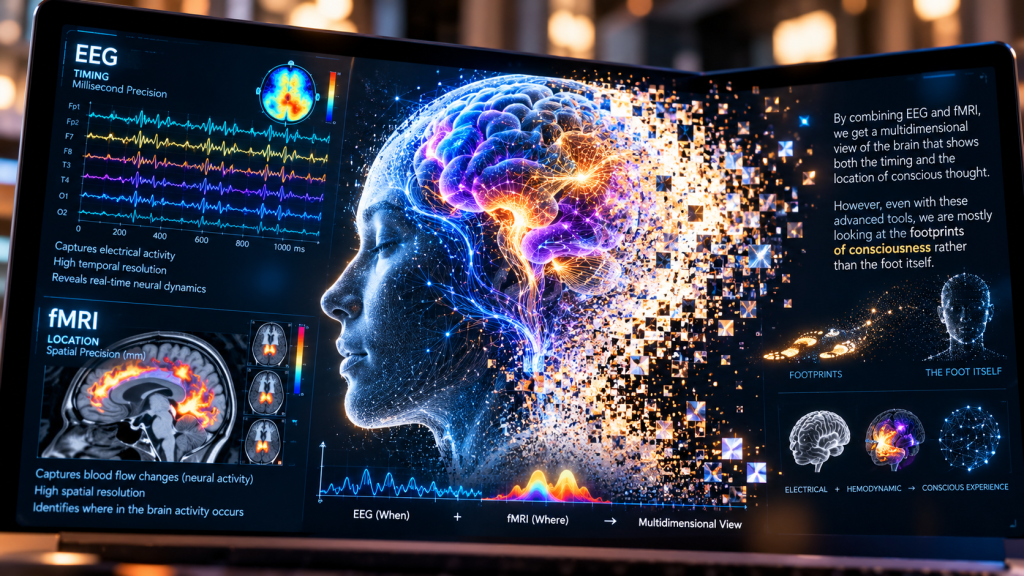
To measure consciousness, scientists first look at the electrical and metabolic activity of the brain. The primary tool for this is Electroencephalography, or EEG. By placing sensors on the scalp, researchers can detect the tiny electrical impulses generated by billions of neurons firing in unison.
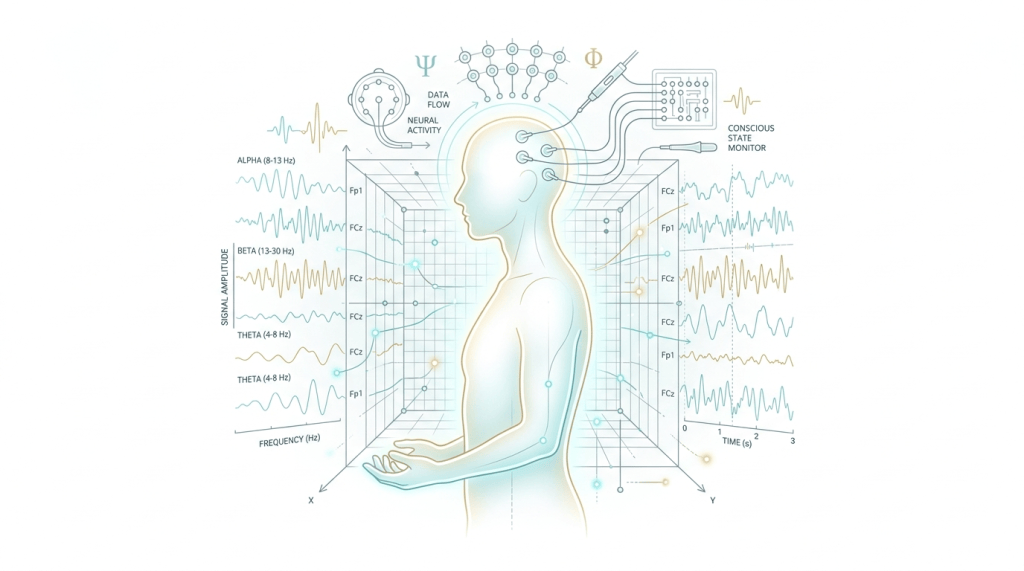
These signals are categorized into brainwave frequencies such as Gamma, Beta, Alpha, Theta, and Delta. Gamma waves are associated with high-level information processing and peak focus, while Theta waves often appear during deep meditation or dreaming. By tracking these frequencies, scientists can determine a person’s state of arousal and their level of cognitive engagement with the world.
While EEG provides excellent temporal resolution, meaning it tells us exactly when something happens, functional Magnetic Resonance Imaging, or fMRI, tells us where it happens. This technology measures changes in blood flow and oxygenation levels. When a specific region of the brain becomes active, it requires more oxygen, and the fMRI captures this metabolic demand. This allows researchers to create detailed maps of the brain during various tasks, such as solving a math problem or feeling empathy for a stranger.
By combining EEG and fMRI, we get a multidimensional view of the brain that shows both the timing and the location of conscious thought. However, even with these advanced tools, we are mostly looking at the footprints of consciousness rather than the foot itself.
Can we find the seat of awareness through neurological experiments?
The search for the seat of the soul has led to the identification of the Neural Correlates of Consciousness, or NCC. These are the minimal neural events and structures sufficient for a specific conscious perception. In numerous experiments, scientists use visual illusions or masked stimuli to see which parts of the brain ignite when a person becomes aware of an image versus when they process it subconsciously. One prominent theory, the Global Neuronal Workspace, suggests that consciousness emerges when information is broadcast across a wide network of brain regions, making it available for various cognitive processes.
Another fascinating area of research involves split-brain patients and individuals with localized brain damage. By observing how consciousness changes when certain pathways are severed, researchers have learned that the brain is highly modular yet incredibly integrated. For instance, the claustrum, a thin sheet of neurons deep within the cortex, is often cited as a potential coordinator of conscious activity, acting like a conductor for a vast biological orchestra. Despite these findings, neurological experiments often struggle to explain the transition from objective cellular firing to the subjective feeling of seeing the color red or feeling the warmth of the sun. This gap is known as the hard problem of consciousness, and it suggests that our current experiments may only be scratching the surface.
What role does heart-brain coherence play in our conscious experience?
One of the most significant breakthroughs in modern biophysics is the discovery that the heart is more than just a pump. It possesses its own intrinsic nervous system, often called the little brain in the heart, consisting of approximately 40,000 neurons. These neurons can sense, feel, and remember. The heart and brain are in constant communication through the nervous system, hormones, and electromagnetic fields. When we experience positive emotions like gratitude or compassion, the heart rhythm becomes smooth and ordered. This state is known as heart-brain coherence.
High levels of coherence lead to a state of global synchronization where the brain functions more efficiently. Research shows that when the heart is in a coherent state, it sends signals to the brain that enhance emotional regulation and cognitive clarity. This is why heart-centered practices are more than just feel-good exercises. They are biological interventions that shift the body into a state of optimal performance. By measuring Heart Rate Variability, or HRV, scientists can quantify the degree of coherence and provide real-time feedback to individuals looking to master their internal state. This suggests that consciousness is not localized solely in the skull but is a distributed process involving the entire body-field.
Why is neuroplasticity the key to evolving our level of consciousness?
The old paradigm of the brain suggested that we were born with a fixed set of neurons and that our mental capacity peaked in early adulthood. We now know this is false. Neuroplasticity is the brains remarkable ability to rewire itself based on experience and intentional practice. This means that consciousness is not a static trait but a skill that can be developed. By engaging in specific mental exercises, neurofeedback, or even certain forms of deep meditation, we can physically change the structure and function of our brains.
Neuroplasticity allows us to break free from habitual patterns of thought and emotional reactivity. When we consciously choose to focus on new ways of being, we strengthen the synaptic connections associated with those states. Over time, what was once a conscious effort becomes an automatic trait. This is the essence of human potential. We are the architects of our own neural architecture. By understanding the mechanisms of plasticity, we can move from a state of being driven by subconscious programming to a state of conscious evolution, where we intentionally design our mental and emotional landscape.
What are the current limitations of measuring subjective reality?
Despite the incredible progress in neuroimaging, we face significant hurdles in measuring the actual essence of experience. One major limitation is the resolution of our current technology. An fMRI scan can show us a voxel of brain tissue containing thousands of neurons, but it cannot see the individual conversations happening between them. Furthermore, there is a time lag between neural activity and the blood flow changes detected by the scanner. This means we are always looking at a slightly delayed version of reality.
The most profound limitation, however, is the privacy of the subjective mind. No machine can currently feel what you feel. We can see the brain lighting up in response to music, but we cannot measure the specific, personal meaning that music holds for the listener. This is why behavioral observations and self-reporting remain vital in consciousness research. We must rely on the word of the observer to correlate the data from the machine with the reality of the experience. Until we develop technology that can interface directly with the qualia of the mind, our measurements will remain indirect descriptions of a much deeper phenomenon.
How does quantum coherence redefine our understanding of the brain?
Some researchers argue that classical biology is insufficient to explain the speed and complexity of the human mind. This has led to the emergence of quantum consciousness theories, such as the Orchestrated Objective Reduction theory proposed by Roger Penrose and Stuart Hameroff. This theory suggests that consciousness originates from quantum vibrations within microtubules, which are structural components of neurons. These quantum events would allow for a level of information processing that far exceeds anything possible in a classical system.
Quantum coherence refers to the state where particles become unified and act as a single entity. If the brain utilizes quantum coherence, it could explain how we achieve instantaneous integration of information across different regions. This perspective views the brain as a quantum-biological computer that interfaces with the fundamental fabric of the universe. While this remains a controversial and frontier area of science, it opens up radical possibilities for consciousness technology. If we can learn to influence these quantum states, we might unlock abilities for deep healing, expanded awareness, and a profound connection to the world around us that transcends our current physical boundaries.
The Quantum Coherence Protocol for Peak Awareness
Cultivate a state of intentional gratitude for five minutes daily to shift the electromagnetic field of the heart into a high-coherence pattern that optimizes brain function.
Monitor your Heart Rate Variability using a wearable device to identify your baseline levels of internal stress and physiological coherence. Practice heart-focused breathing for ten minutes each morning by inhaling for five seconds and exhaling for five seconds while focusing on the area of the heart.
Use neurofeedback or brainwave entrainment apps to target Alpha and Theta states, encouraging the brain to move out of high-stress Beta patterns. Engage in novelty-based learning or new physical movements daily to stimulate neuroplasticity and the growth of new synaptic connections.
Implement a digital sunset by removing all screens one hour before sleep to allow the brain to transition into the Delta frequencies necessary for deep consciousness restoration.


Leave a Reply