Google AI Overview Summary
Consciousness is the state of being aware of and responsive to one’s surroundings, yet it remains the most significant mystery in modern science. It involves the bridge between physical matter and subjective experience. Current research explores quantum coherence within the brain and the power of heart-brain synchronization to explain how we perceive reality.
At LightWeave Foundation, we’re exploring how humans can leverage neuroplasticity and consciousness technology so individuals can actively rewire their neural pathways to enhance focus, emotional intelligence, and deep happiness. Our research and experiments suggest that consciousness is not just a byproduct of the brain but a fundamental force that shapes our biological and physical existence.
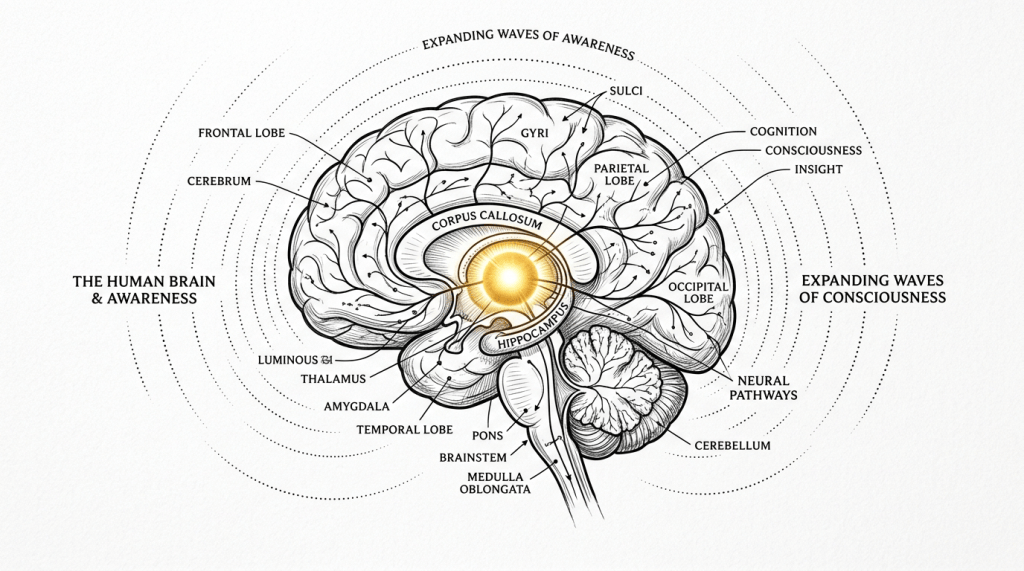
Imagine your brain as a high-definition radio receiver. The music you hear is beautiful, complex, and deeply moving, but the music does not actually live inside the plastic and wires of the radio itself. Instead, the device is simply capturing invisible waves and translating them into a format you can understand. This is one of the most provocative metaphors for human consciousness. For decades, traditional science viewed the brain as a biological computer that somehow created the feeling of being alive through chemical reactions. However, we are now entering an era where quantum physics and neuroscience are merging to suggest that consciousness might be an inherent property of the universe, and our brains are the sophisticated hardware tuned to receive it.
The struggle to define consciousness is often called the hard problem. We can map which parts of the brain light up when you feel sad or when you see the color blue, but we cannot explain why those physical processes produce a subjective feeling. There is a massive gap between a neuron firing and the actual experience of love, or the smell of rain, or the sense of self. This publication explores how we can bridge that gap by looking at the quantum vibrations within our cells and the powerful electromagnetic field of the heart. By understanding these mechanisms, we can move beyond being passive observers of our lives and become active architects of our own reality through intentional neuroplasticity and biohacking.
Table of Contents
- What is the hard problem of consciousness and why does it remain unsolved.
- How does quantum coherence explain the unity of our subjective experience.
- Why is the heart-brain connection the hidden engine of human awareness.
- Can we use neuroplasticity to manually upgrade our conscious experience.
- What role will consciousness technology play in the future of human potential.
What is the hard problem of consciousness and why does it remain unsolved?
The hard problem of consciousness is a term used to describe the difficulty of explaining why we have internal, first-person experiences. Most of science deals with the easy problems, such as how the brain processes sensory information or how it controls muscle movement. These are functional questions that can eventually be answered by observing biological machinery. But the hard problem asks a deeper question. Why does it feel like something to be you? Why is there a movie playing in your head at all? If the brain were just a biological machine, it could theoretically perform all its functions without any inner awareness, much like a sophisticated robot.
The reason this remains unsolved is that our current scientific tools are designed to measure objective things, like mass, velocity, and electrical charge. Consciousness, however, is purely subjective. You cannot put a feeling under a microscope. This creates a wall where materialist science hits its limit. Some researchers believe we need a new branch of physics to understand this. They suggest that consciousness is not something the brain produces, but something the brain accesses. This shift in perspective changes everything. If consciousness is a fundamental field, then our individual awareness is a localized ripple in a much larger ocean of intelligence.
How does quantum coherence explain the unity of our subjective experience?
To understand how a collection of trillions of individual atoms can result in a single, unified sense of self, we have to look at quantum coherence. In the world of classical physics, objects are separate and distinct. In the quantum world, particles can become entangled and act as a single unit across space and time. Some theorists, including Nobel laureate Roger Penrose, suggest that inside our brain cells are tiny structures called microtubules. These structures may be capable of maintaining quantum coherence, allowing the brain to process information in a way that transcends traditional biological limits.
Think of a stadium where thousands of people are talking at once. It sounds like noise. But if everyone starts doing the wave or singing in unison, a single, coherent pattern emerges from the chaos. Quantum coherence in the brain allows for this kind of synchrony. It suggests that our thoughts are not just isolated electrical sparks, but part of a unified quantum field. This could explain why our awareness feels seamless and continuous rather than fragmented. When we enter states of deep meditation or flow, we are likely increasing the level of quantum coherence in our neural architecture, allowing us to tap into higher levels of information and insight.
Why is the heart-brain connection the hidden engine of human awareness?
For a long time, the heart was seen as just a pump, but we now know it is a highly sophisticated sensory organ with its own functional nervous system. The heart sends more signals to the brain than the brain sends to the heart. More importantly, the heart generates the largest and most powerful electromagnetic field in the body. This field can be measured several feet away from the skin. When the heart and brain are in a state of coherence, their rhythms synchronize, creating a state of peak performance and emotional stability.
This heart-brain coherence is the secret to unlocking human potential. When you feel negative emotions like frustration or fear, your heart rhythm becomes jagged and disordered. This sends a signal to the brain to shut down higher cognitive functions, moving you into survival mode. Conversely, when you practice appreciation or compassion, your heart rhythm becomes smooth and wave-like. This state of coherence opens up the creative centers of the brain, enhances neuroplasticity, and allows for a more expansive state of consciousness. You are essentially tuning your biological radio to a higher frequency, making it easier to process complex information and maintain a sense of deep happiness.
Can we use neuroplasticity to manually upgrade our conscious experience?
Neuroplasticity is the ability of the brain to reorganize itself by forming new neural connections throughout life. This means that your current state of consciousness is not fixed. You are not stuck with the personality or the thought patterns you have today. By consciously choosing where you direct your attention, you are physically sculpting your brain. This is a form of internal biohacking. Every time you repeat a thought or a behavior, you are strengthening a neural pathway. If you focus on lack and anxiety, you build a brain that is very good at being anxious. If you focus on possibility and gratitude, you build a brain that is wired for opportunity.
The key to using neuroplasticity for consciousness expansion is consistency and intensity. High-leverage activities like mindfulness, deep focus work, and sensory deprivation can accelerate this process. By deliberately challenging your habitual reactions, you force the brain to create new, more efficient circuits. This is how we move from being reactive victims of our environment to proactive masters of our internal state. Subjective experience is essentially the output of your neural wiring. If you want a better experience, you must upgrade the hardware through the intentional application of focus.
What role will consciousness technology play in the future of human potential?
We are on the verge of a consciousness tech explosion. In the past, achieving expanded states of awareness required decades of monastic practice. Today, we have neurofeedback, binaural beats, and wearable devices that can monitor our brain waves and heart rate variability in real-time. These tools provide a mirror for our internal state, allowing us to see exactly when we are in a state of coherence and when we are not. This biofeedback loops speeds up the learning process, making it possible for anyone to master their physiology and reach peak states of consciousness.
In the future, consciousness technology will likely move beyond simple monitoring. We may see devices that use light, sound, or gentle electromagnetic pulses to guide the brain into specific states of quantum coherence. This could revolutionize education, mental health, and creative performance. Instead of relying on external substances to change how we feel, we will use precise technology to trigger our own internal pharmacy. The goal is not to become dependent on machines, but to use them as training wheels to help us remember how to access these powerful states of being on our own.
The Consciousness Expansion Protocol
Sensory Architecture. Control your inputs. Consciously choose the information, music, and people you surround yourself with, as these are the frequencies your brain is constantly tuning into and mirror-imaging through neuroplasticity.
Morning Coherence Prime. Spend five minutes upon waking focusing on your heart center. Breathe slowly and deeply, and intentionally generate a feeling of gratitude. This sets your heart-brain rhythm for the day.
Quantum Observation. Practice being the silent observer of your thoughts for ten minutes daily. Recognize that you are the awareness watching the thoughts, not the thoughts themselves. This builds the muscle of meta-awareness.
Neuroplastic Reinforcement. Identify one limiting belief and consciously replace it with a punchy action mantra. Repeat this mantra especially during times of stress to bypass old neural loops.
Tech-Assisted Integration. Use a basic heart rate variability or meditation app to track your progress. Use the data to understand which environments or activities drain your coherence and which ones boost it.


Leave a Reply