Overview
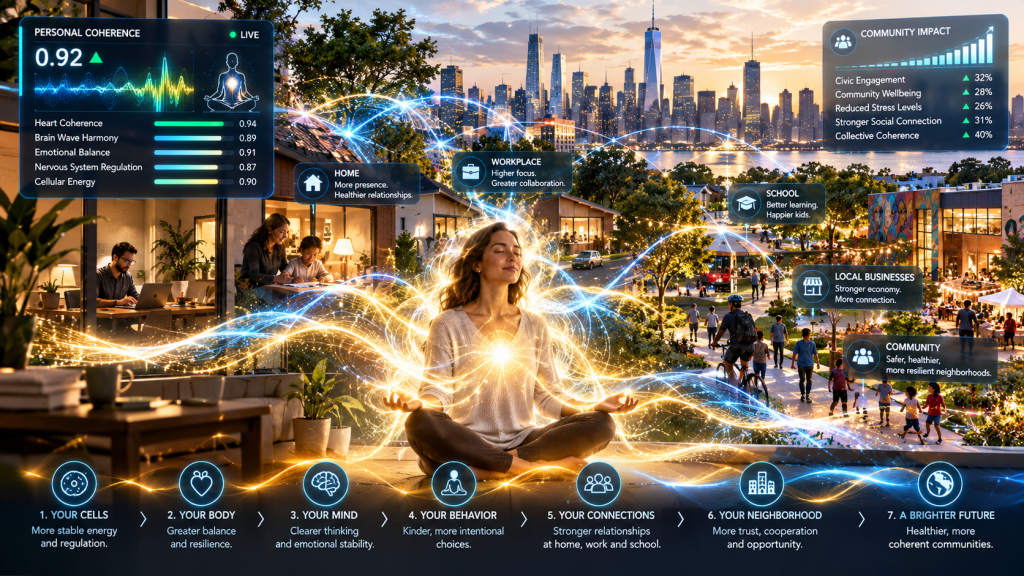
Measuring the impact of a transformative experience involves looking at quantum coherence in the body and brain. Real change is tracked through neuroplasticity, heart-brain alignment, and sustained behavioral shifts. It moves beyond just feeling inspired to seeing tangible changes in how a person reacts to stress and interacts with their community. True success is defined by a person’s ability to maintain a high internal state regardless of external circumstances.
Imagine you just finished a massive weekend retreat or a deep coaching session. You feel like you could fly. You are buzzing with energy and everything seems possible. The world looks brighter, and you feel like you have finally figured it all out. But then Monday happens. Two weeks later, you are back in traffic, yelling at the car in front of you and feeling the same old knots in your stomach. Did that experience actually do anything?
The real world is the laboratory for human potential. To measure impact, we have to look at the intersection of your physical hardware and your energetic software. This means looking at how your heart and brain talk to each other and whether your neurons are actually building new bridges.
We are moving away from simple surveys that ask if you liked the snacks and moving toward a deeper understanding of human evolution. We want to see how one person becoming more coherent changes an entire company or community.
When we measure change, we are looking for the ripple effect that starts in your cells and ends in your community. We believe our research, experiments, and the consciousness technologies that we have been building, installing, and experimenting can help us all get one step closer to accomplishing that goal – and together, in this manner, with the power of the “ripple effect”, make the world a better place for all of us.
Table of Contents
- Why does neuroplasticity require more than just a good idea?
- How does heart-brain coherence show up in your daily stress?
- What are the telltale signs of a behavioral shift in the real world?
- How do we measure the ripple effect in a community?
- Why is participant feedback only the beginning of the story?
- How can we use follow-up actions to prove a quantum shift occurred?
Why does neuroplasticity require more than just a good idea?
Think of your brain like a giant field of tall grass. Every time you think a thought or do an action, you walk a path through that grass. Over years, those paths become deep, muddy ruts. These ruts are your habits, your fears, and your automatic reactions. When you have a big realization at a workshop, it is like seeing a map of a better path from a helicopter. You see where you want to go, but when you land back on the ground, the grass is still tall and the old muddy paths are still there. Neuroplasticity is the ability to stop walking the old muddy path and start treading a new one until it becomes the easiest way to travel.
To measure this, we do not just ask if you liked the experience. We look for evidence that you are making different choices under pressure. If you used to reach for a cigarette or a sugary snack when stressed but now you automatically take three deep breaths, your brain hardware is physically changing. We look for the persistence of these new paths over time. Neuroplasticity is not about a single moment of clarity. It is about the construction crew in your head building new neural bridges because you are giving them new orders every single day. True impact is measured by how much of that tall grass has been flattened into a permanent new road.
How does heart-brain coherence show up in your daily stress?
Have you ever felt like your head says yes but your gut says no? Or perhaps your mind is racing with a million thoughts while your heart feels heavy and slow? That is a lack of coherence. It is like an orchestra where the violins are playing jazz and the drums are playing heavy metal. Quantum coherence is when all the parts of a system are working in a perfect, rhythmic dance. Your heart has its own nervous system with about forty thousand neurons. It is essentially a second brain. When your heart rhythm is smooth and your brain waves are synchronized, you enter a state of high performance and deep peace.
We measure this through something called heart rate variability. If a person can maintain a steady, resilient heart rhythm even when things go wrong, they have achieved heart-brain coherence. This is a physical metric of a spiritual or psychological experience. If you are in a meeting and someone insults your work, does your heart rate spike into a jagged, chaotic pattern? Or can you keep it smooth and steady? When you are coherent, you have access to your full intelligence and your best self. Measuring this shift tells us if the experience actually upgraded your internal operating system or if it was just a nice vacation for your mind.
What are the telltale signs of a behavioral shift in the real world?
A real shift looks like something you can actually see in a video. If we filmed your life before a major realization and then filmed it three months later, what would be different? Maybe you spend less time complaining to your coworkers. Maybe you finally start that creative project you have been putting off for five years. These are behavioral indicators. We look for a change in the baseline of your daily life. Anyone can be nice for an hour after a meditation session, but can you be kind when you are tired, hungry, and running late for an appointment?
Real impact is measured by how your default settings have been reprogrammed. We look for changes in how you spend your time, who you spend it with, and how you speak to yourself. If your internal dialogue has shifted from I cannot do this to how can I make this work, that is a massive indicator of success. Behavioral changes are the evidence of your new quantum state. When your internal frequency changes, your external actions must follow. If the actions do not change, then the experience was just a pleasant daydream. We want to see the boots on the ground proof that you are living a different life.
How do we measure the ripple effect in a community?
No one is an island in the quantum field. We are all entangled. When you change your internal state and become more coherent, you change the frequency of the people around you. This is the community-level result. We measure this by looking at the quality of your relationships and the environment you inhabit. Are your children calmer because you have learned how to regulate your own emotions? Is your workplace more collaborative because you stopped competing and started creating? The impact of a single experience can be measured by the health of the entire ecosystem surrounding the individual.
If you go to a retreat and come back more judgmental or more isolated, then the experience failed to create true quantum coherence. True coherence is inclusive and harmonizing. We look for a decrease in conflict and an increase in contribution. When people are truly transformed, they naturally want to help others and share their new state of being. The metric of success here is the positive change in the people who never even attended the event but are influenced by your new way of existing. This is the true power of human potential, a single light that helps others find their own way.
Why is participant feedback only the beginning of the story?
Usually, people fill out a form right after an event saying they loved the speakers and the music. We call this the glow effect. While it is nice to know people had a good time, this feedback is only the tip of the iceberg. To measure real human potential, we need to look at what happens thirty, sixty, and ninety days later. We need to know if the participant actually changed their morning routine or if they finally had that difficult conversation they had been avoiding. Feedback is only useful if it is tied to an action.
We look for long-term data points that show a person is not just talking about change but living it. Did they sign up for a follow-up course? Did they start a local meetup group? Did they report a sustained increase in their overall life satisfaction? Real feedback comes from the results of a person’s life, not just the words they write on a survey when they are still feeling the high of a weekend event. We value the quiet, steady progress over the loud, temporary excitement. The most important feedback is the story your life tells after the music stops.
How can we use follow-up actions to prove a quantum shift occurred?
A quantum shift is a jump from one state of being to another. In physics, an electron jumps to a higher energy level and stays there. In human life, this means you stop being the person who is victimized by circumstances and become the person who creates them. The best way to prove this happened is through follow-up actions. These are the small, consistent steps that anchor the new energy into the physical world. If you do not take action, the energy of the experience eventually dissipates.
We track these actions as milestones of evolution. Did you implement a new health protocol? Did you change the way you manage your finances? Did you forgive someone who hurt you? These actions are the anchors that keep you from drifting back into your old muddy ruts. When we see a series of new actions being taken consistently, we know that a real shift has occurred. This is how we move from the world of ideas into the world of results. Your actions are the ultimate proof of your transformation and the primary way we measure the impact of any experience.
Action Protocol for Measuring Impact
- Review your progress every ninety days to ensure the new neural paths are becoming your permanent default., a workout, or a learning session, give yourself at least five minutes of silence. No screens and no distractions. Let the brain hit the save button through reflection.
- Set a baseline by recording your current reactions to three major stressors in a journal.
- Engage in a heart-brain coherence practice for ten minutes every morning for thirty days.
- Use a tracker to note three specific times each week you chose a new behavior over an old habit.
- Ask a trusted friend or partner for honest feedback on any shifts they notice in your energy or patience.


Leave a Reply