Summary
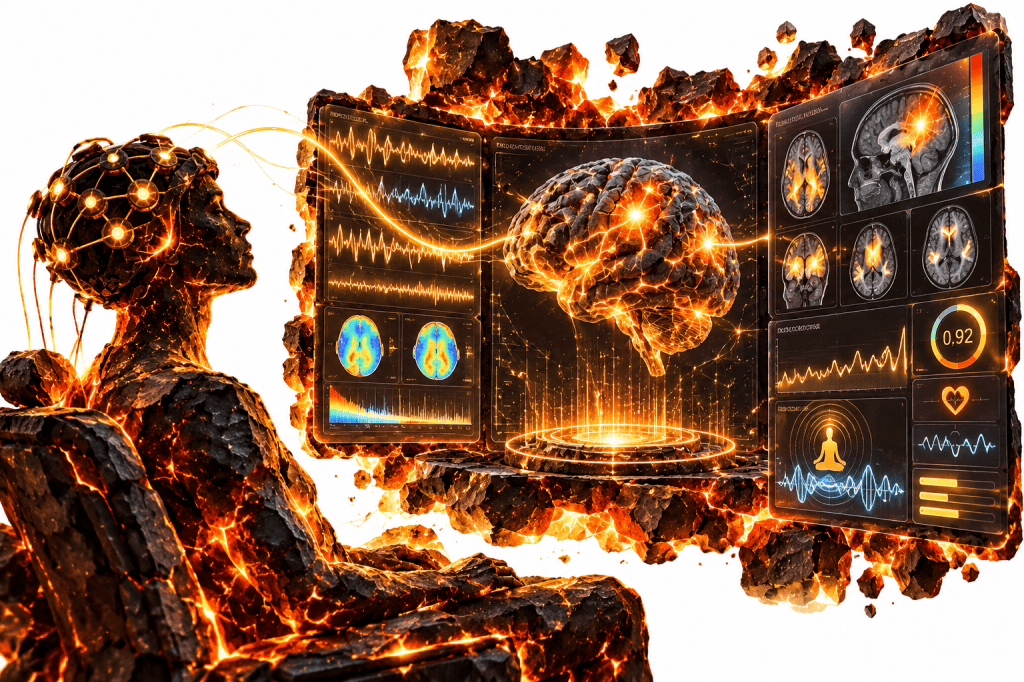
Consciousness technology refers to an emerging suite of tools and practices, including neurofeedback, heart-rate variability monitors, and immersive sensory environments, designed to bridge the gap between internal biology and external perception. By leveraging the principles of neuroplasticity and fostering heart-brain coherence, these technologies allow individuals to consciously rewire their neural pathways. This process fundamentally transforms how the brain filters sensory data and processes emotions, leading to a profound shift in how objective reality is perceived and experienced. Ultimately, this field suggests that human potential is not fixed but is a malleable interface that can be optimized for deep happiness and cognitive clarity.
Imagine your brain as a sophisticated radio receiver. For most of your life, you may have been stuck on a station filled with static, stress, and outdated emotional patterns. You likely assumed the static was simply part of the broadcast, an unchangeable feature of your existence. However, the burgeoning field of consciousness technology suggests that you are not merely a passive listener to your own life, you are the lead engineer. Through the targeted application of biophysics and neurofeedback, we are discovering that the physical structures of the brain and the electromagnetic rhythms of the heart are far more flexible than 20th-century science ever imagined. This is the new frontier of human evolution, where we move from accidental living to intentional design.
This transformation is rooted in the biological reality of neuroplasticity. Every thought you repeat, every environment you inhabit, and every technological tool you interact with acts as a sculptor for your nervous system. When we combine high-tech feedback loops with ancient reflective practices, we create a state known as quantum coherence. In this state, the heart and brain function in a synchronized rhythm, allowing for peak performance, emotional resilience, and a sense of interconnectedness. We are entering an era where the limits of human potential are being redefined. By understanding the mechanics of our own awareness, we can unlock levels of deep happiness and creative insight that were previously reserved for the elite few.
Table of Contents
- How does quantum coherence link the heart and the brain?
- Can we actually re-engineer our neural pathways through technology?
- What role do sensory environments play in shaping our perception?
- Is deep happiness a measurable biological state or a choice?
- How does neurofeedback bridge the gap between intention and action?
- The protocol for upgrading your conscious experience.
How does quantum coherence link the heart and the brain?
The heart is much more than a simple pump for blood. It is a highly complex sensory organ with its own functional nervous system, often referred to as the little brain. This localized network consists of roughly 40,000 neurons that can sense, feel, and remember. When the heart and brain are in a state of coherence, they communicate through a high-speed exchange of electromagnetic signals and chemical messengers. Quantum coherence, in this context, refers to a state of order and harmony where the electromagnetic field of the heart synchronizes with the brain’s alpha and theta waves.
When you experience feelings like appreciation or compassion, your heart rhythm becomes smooth and ordered. This orderly signal travels up the vagus nerve to the brain’s emotional centers, signaling that the environment is safe. In response, the brain’s higher cognitive functions come online, allowing for better decision-making and creative problem-solving. This is the bio-quantum interface at work. By consciously shifting our internal state, we change the frequency of our heart’s field, which in turn influences the neural processing of the brain. This synchronization is the foundation of a resilient and expanded state of consciousness.
Can we actually re-engineer our neural pathways through technology?
Neuroplasticity is the brain’s ability to reorganize itself by forming new neural connections throughout life. For a long time, it was believed that the brain was fixed after childhood, but we now know that it remains plastic and responsive even in old age. Consciousness technology takes advantage of this by providing real-time data on brain activity. Tools such as electroencephalography (EEG) headsets allow us to see which parts of our brain are overactive or underactive. When we can see our brain waves on a screen, we can learn to change them through a process of trial and reward.
This is essentially the same as going to a mental gym. Just as lifting weights creates micro-tears in muscle that lead to growth, focused mental exercises assisted by technology create new synaptic pathways. When we use technology to guide us into specific states, such as deep focus or profound relaxation, we are strengthening the neural highways associated with those states. Over time, the brain begins to favor these new, more efficient paths over the old, stress-based ones. This is how we move from being victims of our habitual reactions to being architects of our cognitive future.
What role do sensory environments play in shaping our perception?
Our environment is a constant stream of information that our nervous system must filter and interpret. Most modern environments are filled with chaotic stimuli, such as blue light from screens, industrial noise, and cluttered spaces. These inputs often keep our brains in a state of high-beta arousal, which is associated with stress and anxiety. However, by intentionally designing our sensory environments, we can influence our internal state. This is known as sensory hacking or environmental biophysics.
Research shows that certain frequencies of light and sound can induce specific brainwave states. For example, biophilic design, which incorporates natural elements like greenery and natural light, has been shown to lower cortisol and increase cognitive function. Similarly, technologies like binaural beats or specific light-flicker rates can encourage the brain to enter a flow state. When we surround ourselves with coherent patterns, our internal biology tends to mirror that order. By controlling our external inputs, we gain a powerful lever to shift our internal experience of reality.
Is deep happiness a measurable biological state or a choice?
Deep happiness is often misunderstood as a fleeting emotion tied to external events. From a neuroscientific perspective, however, it is better described as a baseline state of the nervous system. This state is characterized by high heart-rate variability and a balanced autonomic nervous system. When the body is not stuck in a fight-or-flight response, it naturally gravitates toward a state of equanimity. Therefore, happiness is both a choice and a biological skill that can be developed.
By using consciousness technology to monitor our physiological markers, we can identify exactly what triggers us and what brings us back to center. Deep happiness arises when the brain is no longer caught in a loop of scanning for threats. Instead, it becomes free to engage with the present moment. This shift is measurable. We see it in increased gamma wave activity and a more synchronized relationship between the amygdala and the prefrontal cortex. As we train our systems to return to this baseline more quickly, happiness becomes our default mode rather than a rare occurrence.
How does neurofeedback bridge the gap between intention and action?
The greatest challenge in personal growth is often the gap between knowing what to do and actually doing it. We might intend to stay calm, but our nervous system reacts before we can think. Neurofeedback bridges this gap by making the unconscious conscious. By providing a mirror for our brain’s activity, it allows us to see the physiological precursors to our behaviors. When you can see a spike in stress-related brain waves before you even feel the emotion, you gain a window of opportunity to intervene.
This technology transforms abstract intentions into concrete biological tasks. Instead of trying to think your way out of stress, you learn to shift your brain waves through direct feedback. This creates a powerful sense of agency. You realize that you have the power to steer your own biology in real-time. This mastery over one’s internal state is the ultimate expression of human potential. It allows us to act from a place of clarity and purpose rather than being driven by ancient, reactive survival mechanisms.
The Protocol for Upgrading Your Conscious Experience
- Record and reflect. Keep a simple log of your focus and mood levels. Over time, you will see the correlation between your technological interventions and your subjective experience, reinforcing the neural pathways of self-awareness.
- Establish a coherence baseline. Use a heart-rate variability monitor for five minutes each morning. Practice rhythmic breathing, five seconds in and five seconds out, while focusing on a feeling of gratitude to synchronize your heart and brain.
- Audit your sensory environment. Identify one source of chaotic input in your workspace, such as a noisy fan or harsh lighting, and replace it with a coherent alternative, like nature sounds or warm, full-spectrum light.
- Engage in neural strength training. Utilize a basic neurofeedback app or a meditation aid for ten minutes a day. Focus on maintaining a specific mental state and use the auditory or visual feedback to correct your course when your mind wanders.
- Practice conscious synaptic pruning. Identify one negative thought pattern that frequently arises. When it appears, acknowledge it and immediately pivot to a pre-chosen positive focus. This uses the principle of neuroplasticity to weaken the old connection and strengthen the new one.
- Implement a digital sunset. Remove all blue-light-emitting devices sixty minutes before sleep. This allows your brain to transition from high-beta waves to the alpha and theta waves necessary for deep, restorative rest and subconscious processing.


Leave a Reply